Uvic Campus Community Garden
  • Home
  • About
    • garden mandate
    • History of the Garden
    • current board
    • Staff
    • Annual Reports
    • Contact
    • Location
    • FAQ
  • Get Involved
    • work parties
    • Volunteering
    • board meetings & faq
    • Renting a plot
    • Employment Opportunities
    • Projects and Partnerships
  • Events
    • Events Calendar
  • Photos
    • 2025
    • 2024
    • 2023
    • 2022
    • 2021
    • 2020
    • 2019
    • Spring Social 2018
    • 2017
    • 2016
    • Spring Social 2016
  • Resources
    • Video Tutorials
    • Food Security and Sovereignty
    • Composting
    • Seed Saving
    • Native Plants
    • Online Resources
    • Pests
    • Soil Building
    • When to Plant
    • Weeds
  • sundew
    • submission guidelines
    • issues
  • Blog
  • CCG Mixtape
  • CCG Merch

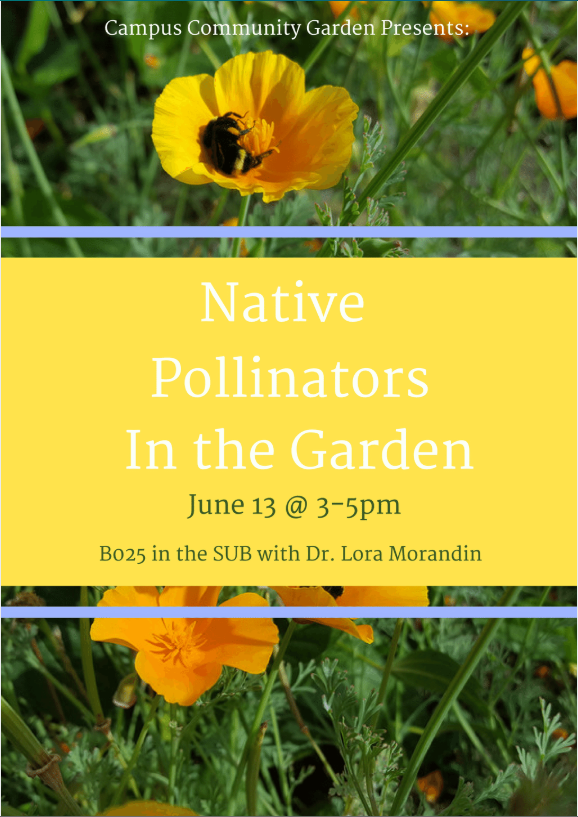
WORKSHOP HIGHLIGHTS: Native POLLINATORS IN THE GARDEN

6/13/2018

1 Comment

 
Picture
There are many different ways in which a plant can pollinate:
  • Gravity
  • Wind
  • Animals
  • Insects
Some Crop Pollination Facts:
Blueberries are called buzz pollinated crops. They need a bee to do high frequency buzzing to release the pollen from the anthers.

In the central valley of california in late march, 70% of the world's almonds are in bloom and produced. 1.7 million honeybee colonies (most of the ones in the US) are trucked in to california to help pollinate these crops. As the honeybee has issues, so do the almond crops.
Squash have both male and female flowers and the pollen needs to travel between these two flowers in order for the plant to produce.
Any monocots/grasses do not need pollinators as they are wind pollinated.
Chocolate is pollinated by the tiny midge fly. Since midge flies like to be in the rainforest, only 2-3% of the flowers on the cocoa trees are pollinated.

Importance of Animal Pollination
  • 87/128 global food crops, about ⅓ of the foods we eat, the most healthiest foods need pollinators
  • A pollinator can be any animal that moves the pollen from the male part of the plant to the female part of the plant. It can be lizards, rodents, insects, bats, but by and far the most important pollinators are the bees.
Bees
  • Honeybees are not native to North America, they were brought over originally for honey production and are now used to agricultural pollination.
  • Before the honeybees were brought over, they were pollinated by our native bees. We have about 200 different types of native bee species on the island, and 450 bee species in British Columbia.
  • There are over 200,000 species of bees in the world
  • Bees are a really diverse group that evolved 120 million years ago from wasps. They have diverged into about 7 different families.
  • Largest bee: carpenter bee
  • Smallest bee: fairy bee
  • A bee is not a wasp, bees are interested in flowers and wasps are interested in your food at picnics. Bees eat pollen and nectar throughout their adult life and it is mostly the only thing they feed to their offspring.
  • Bees are often solitary animals who do not live in hives. But honeybees live in colonies of 20,00-40,000. Solitary bees are often only queen bees. Honeybees will be a bit more aggressive as they have huge colonies to protect.
  • Bees have evolved alongside plants, so they can be sometimes plant-specific which is why it is so important to plant native plants in this area to support our native pollinators
  • Bees are the best pollinators and have declining populations
  • Honeybees are a food system concern, but not a conservation concern, since they are not native.

Honeybees
  • Beekeepers keep honey bees healthy by splitting their colonies in the spring to try to keep the number of colonies up  
  • Honeybees need a diversity in their diet which they do not get when they are tracked from one monoculture to another
  • Honeybees are also being exposed to insecticides in agricultural landscapes
  • Colony Collapse Disorder started in 2006, the acceptable level of loss in the colonies is 15%, and in some places they lose up to 100% of their colonies and the average loss is 35% across the country. It is dropping again in the past few years but
  • In the united states, there are some that have naturalised and have managed to sustain their own populations over long periods of time and survive in the wild. This does not happen often and it does not happen in Canada as it is too cold.
  • Honeybees are not native and can favour invasive species, making them produce more rapidly than native plants and therefore harming the forage of the native bees.

Native Bees
  • Often better pollinators for our gardens than honeybees
  • There are some species that are going extinct, or that have gone extinct. Therefore, we are losing our diversity. However, some native bee populations are increasing! There hasn't been much long term data on native bee populations. They have not been monitored for long.
  • Better pollinators of a lot of crops, they provide stability of services as different species will forage under different conditions, so a diversity of native bee populations is much better at pollinating than honeybees
  • Do not die when they sting
  • Often live in the ground in tunnels on their own
  • They forage close to their nest
  • About 70% of our native bees tunnel their nests into the ground. These guys will not sting you, they're all queen bees.
  • About 30% of our bees are tunnel nesters, so you can put out homes for them in your garden. Building these tunnels will not increase bee population but it is a cool educational project
  • 5-10% are cavity nesters, these are the most closely related to honeybees as they are less solitary. These guys even store a bit of honey.

Habitat Loss, Insecticides and Parasites and Diseases negatively affect both the native bees and the honeybees.

How to Save the Bees?
  • Don’t start farming honeybees. This is not a conservation action.
  • Incorporate native plants, diverse agriculture and natural habitat into farmland
  • Incorporate patches of less intense human use and natural habitats into urban environments
  • Provide habitat: small to medium scale habitat is very beneficial to pollinators.
    • For habitat they need closely interspersed habitat areas as they do not travel far from their nest to forage. Native bees need native plants, they need nesting sites, they need connectivity between foraging sites, they need low competition.
    • Honey bees are not a good model for what most bees need. Honeybees live in highly social colonies, perennial colonies that live from year to year and provide honey for their food for the winter. Honey bees are the only species of bees that live as adults over the winter.
    • They can travel 3-5 km from their nest to forage and pass this information along to their sister bees.
  • Don't have your yards to be all lawn. You can leave some bare patches, some piles of sticks.

Bee Life Cycle
  • Males die very quickly
  • The females are the ones that go out and collect pollen and nectar, make it into a little ball and then lay their eggs in it.
  • The part of the life cycle that you do see the bee is about 1 month of their year.
  • The part of the life cycle where you do not see the bees, lasts about 11 months.
  • The egg, larva and pupa stage of the bee life cycle is all hidden from our eyes.

Plant Selection
  • Resources that tell you what to plant for bees
    • HAT (Habitat acquisition trust)
    • Saanich Native Plants
    • Pollinator.org
    • Island Pollinators
  • Some native plants that are great for pollinators: oceanspray, black twinberry, hardhack, gumweed, camas, salal, snowberry, hookers onion, spring gold, sea blush, douglas’ aster, wooly sunflower. You can get these at Saanich Native Plants if you'd like.
  • AVOID THESE PLANTS: common periwinkle, bachelors button, queen annes lace, butterfly bush, ivy, oxeye daisy, yellow archangel, spurge. These are invasive plants and choke out our native plants. Go to invasive species council of BC to see which plants are invasive.

Why garden for Pollinators?
  • Create healthy, diverse ecosystems
  • Respect the land
  • Increase crop security

Identifying Pollinators
Bee:
  • Small, kidney shaped eyes
  • Medium antennae
  • Forewings
  • Sometimes has pollen lumps on it
  • Sometimes hairy
  • Always have widened back leg
Fly:
  • Big eyes that sometimes meet in the centre
  • Short, stubby antenna
  • Two wings
Wasp:
  • Forewings
  • Small eyes
  • Medium length antenna
  • Wasps are not hairy
  • Have thin back legs

​Bee Breakdown
Non-Native
  1. Honeybee
    1. Can vary in how they look. Can be bight and golden or dark.
    2. Honeybees have big legs that hang down, native bees do not. They are wide and dangle down when the bee is flying.
    3. Carry wet pollen lumps in what is called a corbicula


Native
  1. Bumble Bee
    1. Also have wet pollen lumps and have a corbicula
    2. They have dark, brownish wings
  2. Pollen Pants Bee
    1. Carry pollen on their back legs
    2. Sweat bees and miner bees
  3. Pollen Belly Bee
    1. Carry pollen on their bellies
    2. Mason bees, leafcutter bees
      1. Leafcutter bees create perfect circles on the edges of your leaves and they cut the leaf with their jaws, roll it up and then fly off to their nest to line it  
  4. Other
    1. Everything else
    2. Carpenter bees, yellow face, parasitic
1 Comment
Kinsley Landscape did an amazing job with our lawn! link
9/8/2025 10:34:44 pm

Kinsley Landscape did an amazing job with our lawn! The grass looks greener and healthier than ever. Highly recommend their professional team.

Reply


Leave a Reply.

    Categories

    All

Powered by Create your own unique website with customizable templates.
  • Home
  • About
    • garden mandate
    • History of the Garden
    • current board
    • Staff
    • Annual Reports
    • Contact
    • Location
    • FAQ
  • Get Involved
    • work parties
    • Volunteering
    • board meetings & faq
    • Renting a plot
    • Employment Opportunities
    • Projects and Partnerships
  • Events
    • Events Calendar
  • Photos
    • 2025
    • 2024
    • 2023
    • 2022
    • 2021
    • 2020
    • 2019
    • Spring Social 2018
    • 2017
    • 2016
    • Spring Social 2016
  • Resources
    • Video Tutorials
    • Food Security and Sovereignty
    • Composting
    • Seed Saving
    • Native Plants
    • Online Resources
    • Pests
    • Soil Building
    • When to Plant
    • Weeds
  • sundew
    • submission guidelines
    • issues
  • Blog
  • CCG Mixtape
  • CCG Merch